
There is something incredibly evocative about jasmine.
Unlike flowers whose beauty immediately demands attention through colour, jasmine is quieter. Her delicate white petals are simple and understated, but her fragrance has a presence that lingers long after the flower itself has disappeared.

A story of devotion, healing and presence
It was this contrast that first inspired me to create Jasmine.
I have always been fascinated by the way flowers can evoke emotion. Through my work, I have explored flowers as symbols of beauty, memory, healing and feeling, from Geisha Florals and Healing Florals to Enchantment of Florals. With Jasmine, I wanted to explore something different — the beauty of subtlety.
Rather than creating a design that overwhelms with colour and pattern, Jasmine invites you to pause.

The symbolism of Jasmine
Jasmine has been cherished across cultures for centuries, but it holds a particular significance in Buddhist tradition, where it is associated with purity, spiritual calm and renewal.
Its fragrance is gentle yet unmistakable. There is something almost meditative about it — a scent that can instantly transport you somewhere else, quietening the mind and creating a sense of stillness.

Turning a flower into sculpture
One of the most exciting elements of Jasmine is the way the flowers have been brought to life through carving.
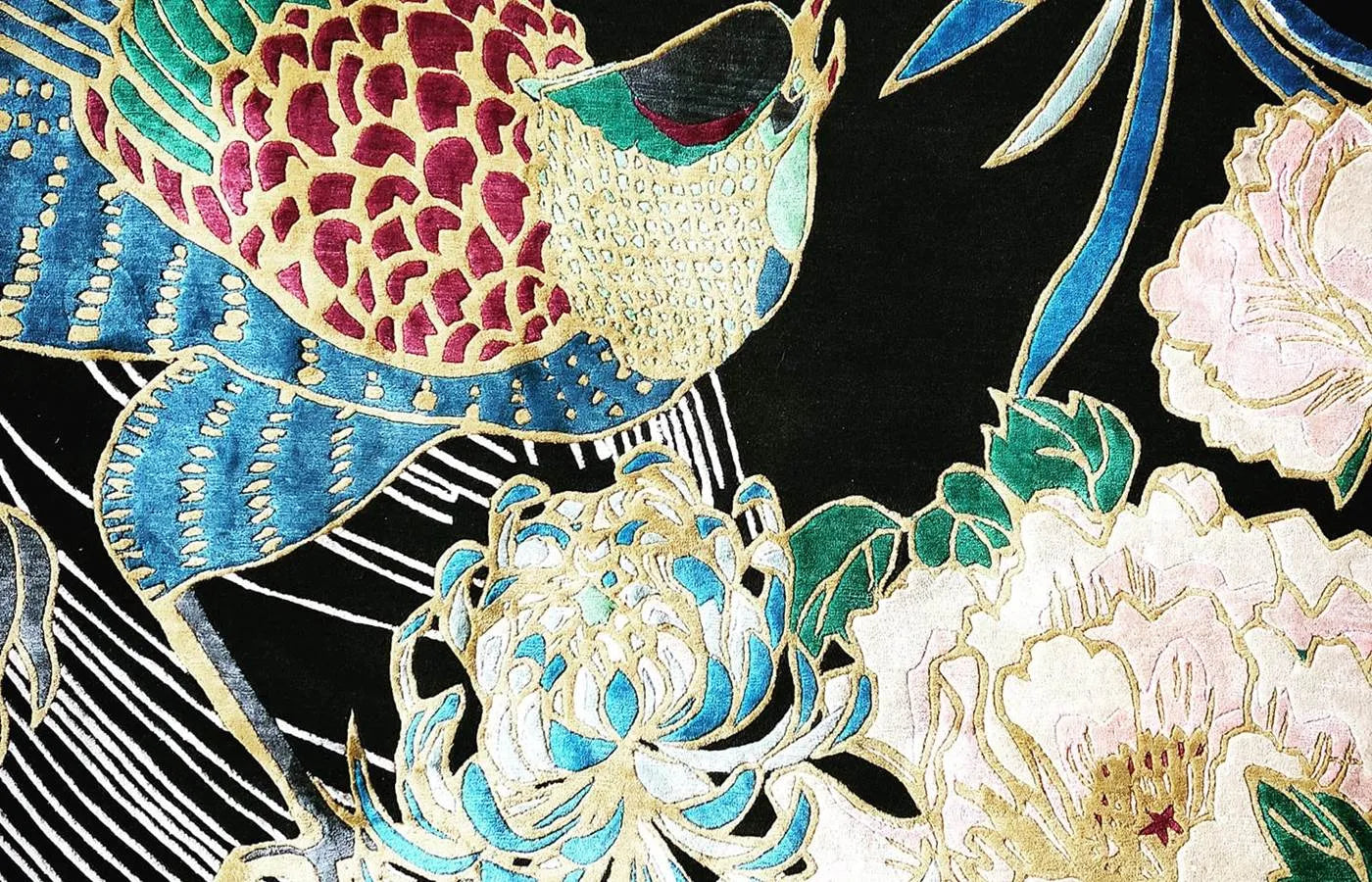
The blooms are created in gentle, curved relief, with each petal carefully sculpted into the surface of the rug. As light moves across the design, subtle shadows appear between the petals, giving the flowers a sense of movement and dimension.


This technique is something I first explored with Mumtaz Mahal. Working with our artisans, I discovered just how much more an artwork can become when it is translated through their hands.
With Jasmine, the carving felt particularly important. The delicacy of the flower needed to be something you could not only see, but feel.
A garden filled with meaning
Amongst the jasmine branches are small details that reveal themselves slowly.
Soft green foliage winds through the design, while three delicate blue swallows appear amongst the branches. Swallows have long been associated with hope, love and safe return — a beautiful sentiment that felt perfectly at home within this story.
Tiny butterflies bring another layer of meaning, symbolising transformation, lightness and change.

Together, these elements create a peaceful little world. There is something to discover each time you look at the rug, but nothing that feels hurried. Your eye can wander through the branches, flowers, birds and butterflies, finding new details as you do.


A design for moments of calm
I imagine Jasmine in the places within our homes where we naturally seek tranquillity.
Perhaps in an entrance hall, where we leave behind the energy of the outside world as we walk through the door.
Or in a bedroom, where the day begins and ends, and where we have the opportunity to reconnect with ourselves.
The softness of the white flowers, the tactile quality of the carving and the gentle movement of the foliage all work together to create a feeling of serenity.
Jasmine isn't designed to overwhelm a space.
She is designed to soften it.
The beauty of simplicity
Perhaps what I love most about Jasmine is the reminder that beauty doesn't always have to be bold.
Sometimes it is found in the smallest things — a delicate white flower, the feel of a petal beneath your fingers, the scent of jasmine carried through an open window.
These are the moments that stay with us.
Through Jasmine, I wanted to capture that feeling: a moment to pause, to breathe and to be present.
Created through the skill and patience of our incredible artisans in India, every carved flower tells a story of craftsmanship. Their hands transform a simple idea into something that can be seen, touched and experienced within the home.
For me, Jasmine is a celebration of devotion, healing and presence.
A reminder that sometimes the quietest things can have the greatest impact.

Beauty doesn't always have to be bold; it can be found in the smallest things.